


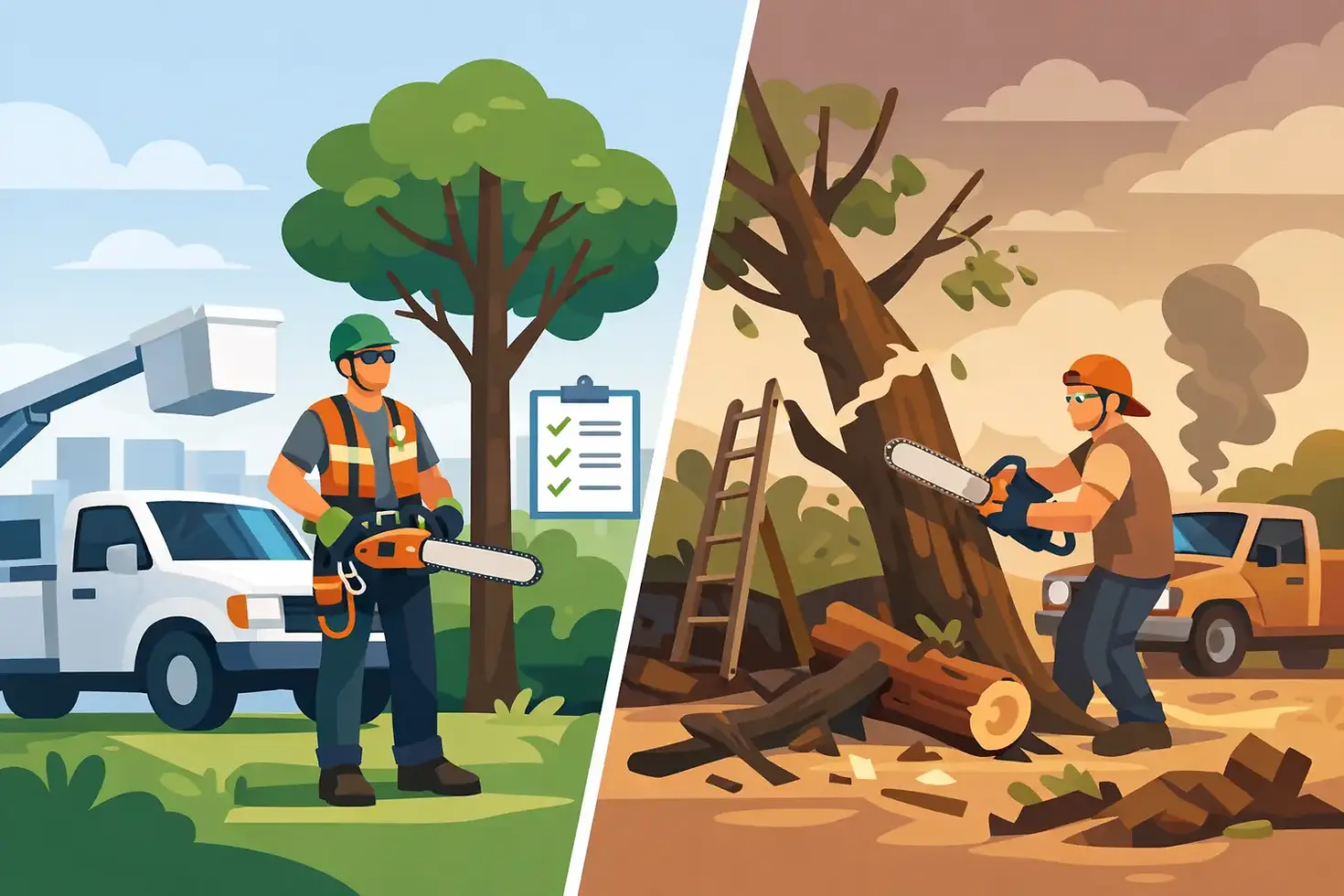
Licensed vs Uninsured Tree Service

A low quote can look great until a branch goes through a roof, a worker gets hurt on your property, or a half-finished job leaves a dangerous tree behind. That is why the difference between licensed vs uninsured tree service matters so much. For homeowners and property owners in Southern California, this is not just about price. It is about safety, liability, and whether the job is handled the right way the first time.
Tree work is high-risk work. It involves chainsaws, ladders, climbing gear, power equipment, heavy falling limbs, and often tight spaces near fences, homes, driveways, and utility lines. When you hire a company, you are not only paying for labor. You are paying for training, coverage, accountability, and a business that stands behind its work.
Licensed vs uninsured tree service: what is the real difference?
A licensed tree service operates as a legitimate contractor. That usually means the business has met state requirements, carries appropriate insurance, and works as a professional company rather than as a cash-only side job. An uninsured tree service may still claim experience, but if there is no proper coverage in place, the customer can end up carrying the risk.
That risk is bigger than many people realize. If a large limb damages your home, a wall, a parked vehicle, or a neighbor's property, someone has to pay for that damage. If a worker is injured while removing a tree or clearing brush, questions about responsibility can quickly become serious and expensive. A lower estimate does not stay low for long if one mistake turns into a claim.
There is also a difference in accountability. Licensed companies have more to protect. They build reputations, maintain compliance, and rely on customer trust to keep working in the community. Uninsured operators can disappear after a problem, leaving the property owner to sort out the damage.
Why cheap tree work can cost more
Most people do not compare licensed vs uninsured tree service because they enjoy researching contractors. They compare them because one estimate is often far lower than the others. That can be tempting, especially when a tree needs immediate attention or brush has gotten out of control.
But lower pricing often reflects what is missing behind the scenes. Insurance premiums, licensing costs, trained crews, proper equipment, and safe job procedures all cost money. A company that carries those responsibilities may not be the rock-bottom option, but it is usually the safer value.
There are cases where a smaller local company offers fair, budget-conscious pricing while still being properly licensed and insured. That is the sweet spot most property owners should look for. The goal is not to pay the highest number on the page. It is to hire a company that protects your property and can finish the job without cutting corners.
What can go wrong with an uninsured tree service?
Sometimes nothing goes wrong. That is the honest answer. A small uninsured operator may complete a simple trimming job without incident. That is why some property owners take the chance.
The problem is that tree work leaves very little room for error. A healthy-looking branch can split unexpectedly. Wind can shift a cut. Hidden decay can make a tree move differently than expected. Equipment can fail. Brush clearing can expose rocks, fencing, irrigation lines, or slope issues. If a crew is uninsured and something goes wrong, the financial fallout may not land on them.
That matters even more in Southern California, where many properties deal with hillside terrain, narrow access, drought-stressed trees, and fire-risk vegetation. Jobs in these conditions are not just yard cleanup. They require planning, skill, and protection for the customer.
How licensing and insurance protect the property owner
When a company is properly set up, the customer has a clearer path if something unexpected happens. That does not mean accidents never occur. It means there is a structure in place to handle them.
Insurance helps cover property damage and jobsite injuries, depending on the type of policy and the situation. Licensing adds another layer of professionalism because it shows the company is operating as a legitimate business, not just offering occasional labor. Together, these basics help reduce the chances that you will be left on your own after a problem.
They also tend to go hand in hand with better business practices. Licensed, insured companies are more likely to provide written estimates, define the scope of work clearly, show up with the right equipment, and communicate what is being removed, trimmed, hauled away, or left behind. That level of clarity matters when the work affects safety and property value.
Licensed vs uninsured tree service when the job is urgent
Emergency situations change how people make decisions. After a storm, a fallen limb, or a tree leaning over a home or driveway, many property owners just want someone there fast. That is understandable.
Still, urgency is exactly when bad hires happen. A crew that knocks on the door and offers immediate tree removal for cash might seem convenient, but urgent work carries even more risk than routine trimming. If the tree is unstable, near a structure, or tangled with other limbs, the chance of property damage rises.
In those moments, ask the basic questions anyway. Are you licensed? Are you insured? Can you provide a written estimate? A legitimate company should be ready for those questions, especially on high-risk work.
What to ask before hiring any tree company
You do not need to become an expert in tree care to hire the right crew. You just need to slow down enough to verify the essentials. Ask whether the company is licensed and insured. Ask what work is included in the quote. Ask whether debris haul-away, stump grinding, or brush removal is part of the price. Ask who is responsible if something is damaged.
It also helps to pay attention to how the company communicates. A dependable contractor explains the job in plain language, shows up when promised, and does not pressure you into a rushed decision. They should be willing to work through the practical concerns that matter to homeowners, such as access, cleanup, safety around structures, and budget.
If a quote is much lower than the others, ask why. There may be a reasonable explanation, but there may also be missing coverage, missing equipment, or missing steps in the work itself.
Why local credibility matters
For property owners in places like Santa Clarita Valley, Antelope Valley, Simi Valley, San Fernando Valley, and nearby Los Angeles County communities, local reputation counts. Tree care is not a one-size-fits-all service. Conditions vary by neighborhood, lot size, slope, tree type, and seasonal fire concerns.
A local company with real roots in the area usually understands those day-to-day issues better than an unknown operator chasing quick jobs. They know that customers are not looking for complicated explanations. They want honest advice, solid work, fair pricing, and a crew that leaves the property in good shape.
That is part of why so many homeowners prioritize companies that are licensed, bonded, and insured. It signals that the business is serious about serving the community, not just collecting a payment and moving on.
The smartest way to compare estimates
When comparing bids, do not treat every estimate as if it covers the same thing. One company may be pricing complete removal, haul-away, cleanup, and safety measures. Another may be pricing only basic cutting and leaving the rest behind. One may be fully insured. Another may not be carrying the protection you assume is standard.
A better comparison looks at value, not just the number at the bottom. What is the scope of work? What protections are in place? How confident are you that the crew can do the job safely and finish it properly?
A trustworthy company should be able to give you clear answers without making the process feel complicated. That is the standard property owners should expect.
Erik's Tree Service & Brush Clearance, Corp. is built around that kind of approach: straightforward communication, safe professional work, and estimates that respect both the property and the customer's budget.
When you hire for tree work, you are not just buying a result. You are choosing how much risk you are willing to bring onto your property. A fair quote from a licensed and insured company usually costs less than the stress of fixing a bad decision later.


Comments