


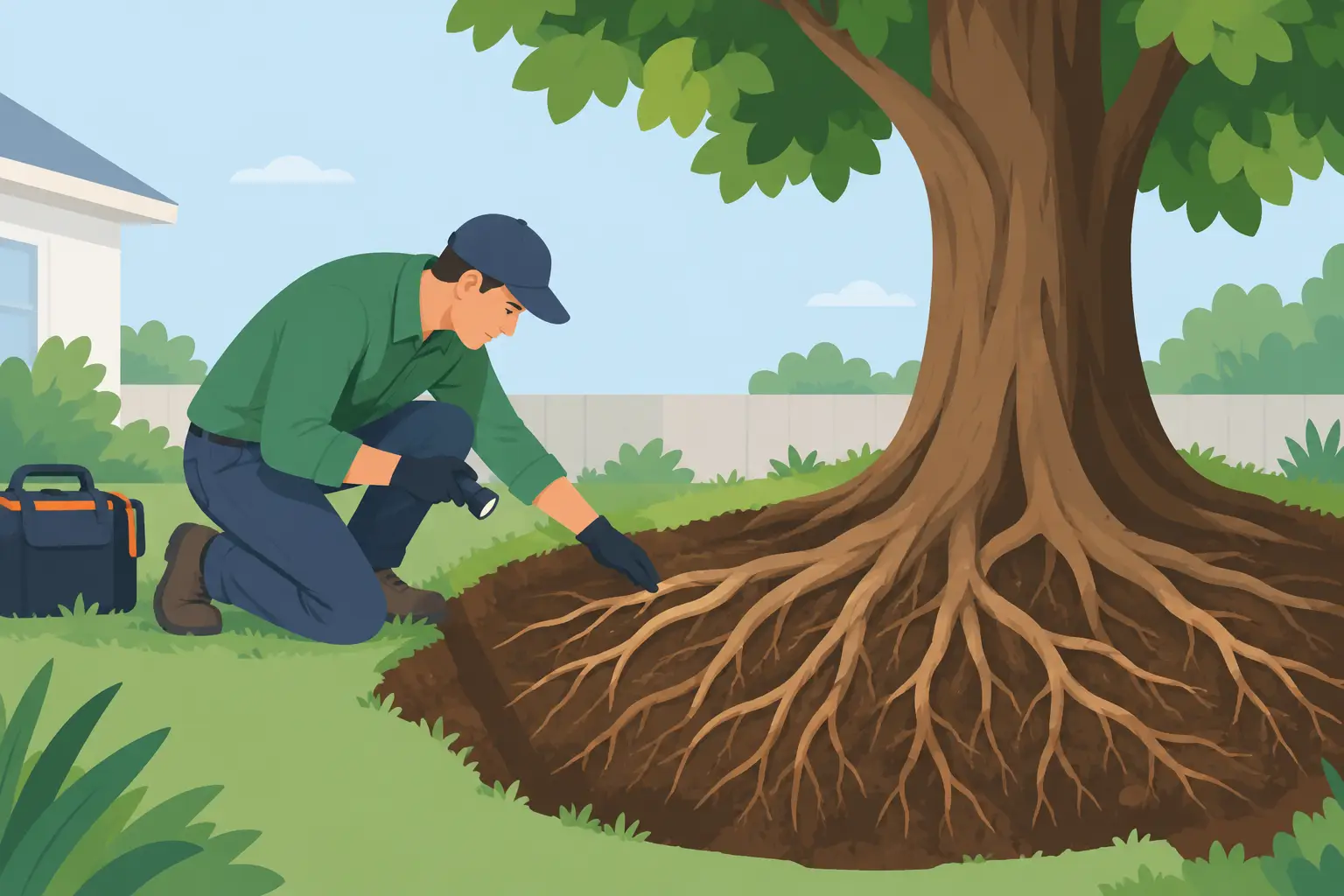
How to Inspect Tree Roots Safely

A tree can look healthy overhead while a problem develops below ground. Soil changes, construction, drought, and too much water can all affect the root system long before leaves start dropping or branches fail. Knowing how to inspect tree roots helps property owners catch visible warning signs without damaging the tree or putting themselves at risk.
For homeowners in Southern California, a root check is especially useful after heavy rain, high winds, nearby digging, or long periods of dry weather. The goal is not to uncover the entire root system. It is to look closely at the soil, trunk base, and exposed roots for changes that may call for professional help.
Start With a Safe Ground-Level Inspection
Begin by walking slowly around the tree from several feet away. Look at the ground and the lower trunk before touching or moving anything. A healthy, established tree should feel stable and have a gradual widening at the base of the trunk, often called the root flare. This is where the trunk transitions into the major roots.
Pay attention to whether the soil has lifted, cracked, or sunk around one side of the tree. Fresh mounding of soil on the opposite side of a leaning tree can mean the root plate is shifting. That can be a serious safety concern, particularly if the tree is near a home, driveway, fence, play area, or power line.
Do not inspect a tree closely during high winds, after a major storm, or when you can see a new lean, broken branches, or exposed roots pulling out of the ground. Keep people and pets away from the area and arrange for an insured tree professional to assess the hazard.
How to Inspect Tree Roots Without Causing Damage
Most root inspections are visual. Digging broadly around a tree, cutting roots, or pulling away large amounts of soil can create the very problem you are trying to avoid. Tree roots are usually much wider than the canopy and many of the smaller feeder roots sit close to the surface.
Clear away loose leaves, fallen branches, and other debris by hand so you can see the soil line around the trunk. If mulch is piled against the bark, gently pull it back several inches. Mulch should be spread across the soil, not shaped like a volcano around the trunk. A thick mulch pile can trap moisture against the bark, hide decay, and encourage roots to grow in the wrong direction.
Use a small hand tool only for light surface work, and only when necessary. Avoid probing deeply or scraping around large roots. If you need to inspect roots because of construction plans, a cracked sidewalk, drainage work, or suspected decay, that is a situation for a qualified tree service. Professionals can evaluate the tree before excavation and help prevent unnecessary root loss.
Check the Root Flare
The root flare should be visible at or slightly above the finished soil grade. When it is buried under soil, mulch, landscape fabric, or decorative rock, the tree may develop girdling roots. These roots circle or press against the trunk and can slowly restrict water and nutrient movement.
Look for a trunk that goes straight into the ground like a telephone pole, rather than widening naturally at the base. Also watch for bark that stays constantly damp, soft areas near the soil line, mushrooms, or decay. None of these signs automatically means the tree will fail, but they deserve a closer evaluation.
Look for Root Damage and Decay
Exposed roots are common, especially on slopes, compacted soil, or older trees. Exposure alone is not always a problem. The concern is when roots are freshly broken, cut, soft, discolored, or damaged by vehicles, trenching, or repeated foot traffic.
Inspect visible roots for wounds, missing bark, fungal growth, or areas that look crushed. A root that was cut during landscape work may affect only a small part of the tree, or it may compromise stability if large structural roots were removed close to the trunk. The impact depends on the tree species, its age, the size and location of the roots, and the amount of damage.
Do not cut a root because it has lifted a paver, edged into a lawn, or grown near a driveway. Removing the wrong root can make a tree unstable or lead to decline months later. The safer solution may involve adjusting the hardscape, improving the grade, or having a professional determine whether selective root work is appropriate.
Warning Signs That Need Professional Attention
A few surface roots are normal. The following changes are more concerning, especially when they appear suddenly or occur together:
A tree that has recently started leaning or has soil lifting around its base
Large roots that are cracked, severed, decayed, or pulling out of the ground
Mushrooms or fungal growth near the trunk base or on major roots
A buried root flare, soft bark, or visible decay at the base of the trunk
Thinning leaves, dieback, early leaf drop, or dead limbs combined with root damage
New cracks in nearby pavement, retaining walls, or soil caused by root movement
These signs do not always require removal. Some trees can be monitored or improved with better watering, mulch correction, pruning, or soil management. However, a tree near a structure or frequently used area should not be left to guesswork when stability is in question.
Consider Southern California Conditions
Southern California trees deal with conditions that can put stress on roots: compacted soils, drought cycles, heat, hillside erosion, and irrigation problems. Both too little water and too much water can cause trouble.
With drought stress, soil can become hard and dry enough that water runs off rather than soaking into the root zone. Trees may respond with thinning canopies, smaller leaves, or branch dieback. Deep, controlled watering may help, but the correct schedule depends on the species, soil type, season, and tree age.
Overwatering creates a different issue. Constantly wet soil limits oxygen around roots and can contribute to rot. If water pools around the trunk after irrigation or rain, inspect the grade and sprinkler pattern. Sprinklers should not spray directly against the bark. Correcting a drainage or irrigation problem early can protect the tree and reduce avoidable property damage.
On slopes, check after rain for exposed roots, soil erosion, and changes in the tree's position. A tree that has lost supporting soil on one side may be less stable even if the canopy still looks green.
When a Root Inspection Should Not Be a DIY Job
Call for professional evaluation if the tree is large, close to a building, growing near utility lines, or showing signs of movement. The same applies when roots may have been affected by trenching for plumbing, fencing, pools, drainage, or landscaping. Root damage is often hidden, and an experienced crew can assess the tree's condition without unnecessary cutting or excavation.
Avoid climbing, pulling on branches to test stability, or using heavy equipment near the root zone. Parking vehicles under a tree, storing materials on its roots, and repeatedly driving over the soil can compact the ground and reduce the roots' ability to take in air and water.
Erik's Tree Service & Brush Clearance, Corp. provides dependable, insured tree care for property owners throughout the Santa Clarita Valley and surrounding Southern California communities. A professional on-site assessment can help you understand whether a tree needs monitoring, pruning, root-zone protection, or more immediate action.
A careful look at the trunk base and surrounding soil can reveal a lot. If something looks different - a new lean, lifted soil, decaying roots, or a struggling canopy - treat it as a reason to get informed early, before a manageable concern becomes a safety issue.


Comments